In July 2025, it was business as usual when standout MLB players travelled to Atlanta for the All-Star Game. What followed was an All-Star first: a swing-off, which saw the National League pull ahead at 7-6.
At the same time, another first was happening behind the scenes. Predictive AI was calling landing zones and, surprisingly, got a few correct, with some caveats. Here’s how the first outing of generative AI at an MLB event went.
Source: Unsplash
MLB’s Statcast AI
This came about as a result of the MLB partnership with Google Cloud, having switched to them over AWS in 2020. That means they took stewardship over Statcast, the league’s number cruncher that gathers player movement analytics from all 30 MLB stadiums.
That’s a lot of stats, as you can imagine. That’s where Google comes in to take all the data, including historical data, and form a profile for every slugger, mapping their best hit angles, typical ball velocities, etc. Ballpark sensors also pick up wind, heat, and humidity, adding them to its calculations. That then gets used to make predictions. Not concrete predictions on what will happen, but predictions on where, if a home run happened, the ball would land, and which player would be the most likely to hit it.
It doesn’t take a supercomputer to look at the field and name the best slugger on there, especially when they’re fan favorites who have become celebrities in their own right. While anything can happen out there, group predictions tend to pan out when averaged to remove the hopefuls and the cynics. It’s called the wisdom of the crowds, and it’s also how sportsbooks and prediction markets can offer favorites without going out of business.
According to BreakingAC, prediction markets can be a great measure of where fan sentiment lies for a variety of sports events, as users buy and sell the probability that their favorite athletes win. Upsets still happen, regardless.
Google Cloud’s job is to show what fans are feeling in observable data, quantifying past and present performance into percentage likelihoods of hitting or heat maps showing which part of the stadium will see the most action. They’re no stranger to the MLB, but the 2025 All-Star Game was the first time they brought generative AI into the equation.
What It Predicted & What It Didn’t
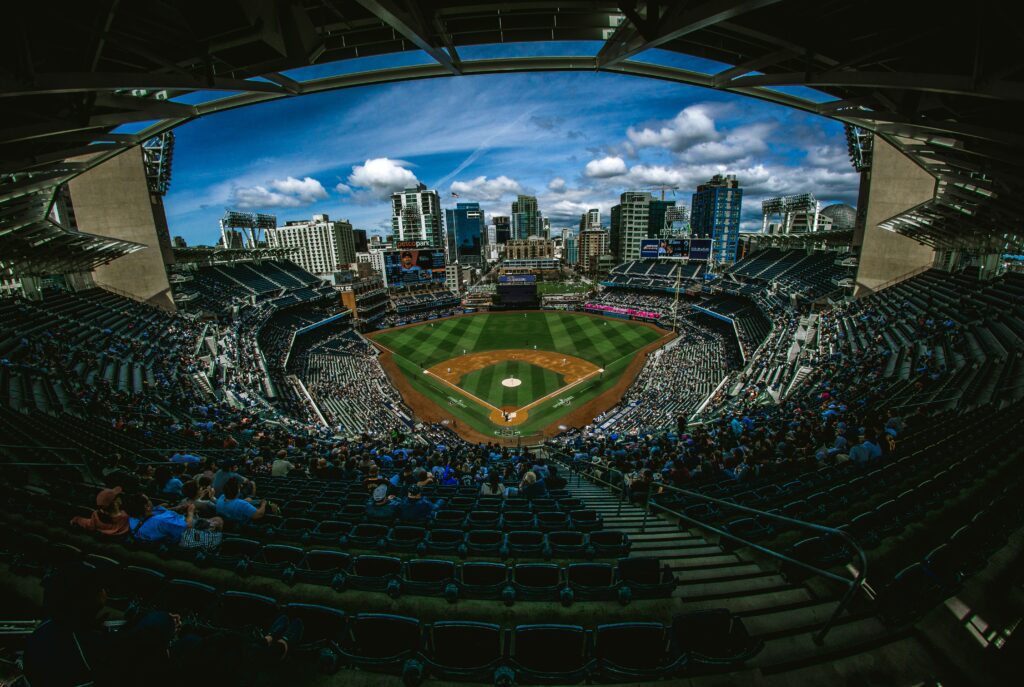
As for what the generative AI did, it served up predictive analysis in a way that fans could read. Everything from the Truist Park jumbotron to vans with screens around Atlanta showed predictive insights into the game. The most common call-out was mapping where balls would land, from the power alley to the specific rows and seats.
Source: Unsplash
The results were mixed, but they were always ‘if’ statements rather than concrete predictions. For example, the pre-game demo used: ‘Hey Seat 3, Row 3, Section 154. Stats show an 81% higher probability Shohei Ohtani sends a souvenir right here.’ That didn’t happen, and neither did a similar Aaron Judge callout, predicting he’d send it into Section 151 if he connected.
However, the biggest hitter of the game, Pete Alonso, sent his three-run home run right into that same predicted power alley based on Statcast metrics. The jumbotron messages had actually subsided by the 6th inning, so it wasn’t exactly a called shot, but it shows the landing zone data is solid. In the swing-off, Kyle Schwarber also hit towards that Section 150-155 power alley, snatching Alonso’s All-Star MVP credit.
It’s more data magic than a crystal ball, but it gives fans another way to engage with the great American game. This year, Google and Statcast pivoted away to other use cases, so we haven’t seen it come back to the field since. Maybe it was punishment for fans’ All-Star voting this year, covered here by FireBrandAL. In time, if the tech catches up, we might see the day where AI calls a shot live, and then it happens exactly as predicted.