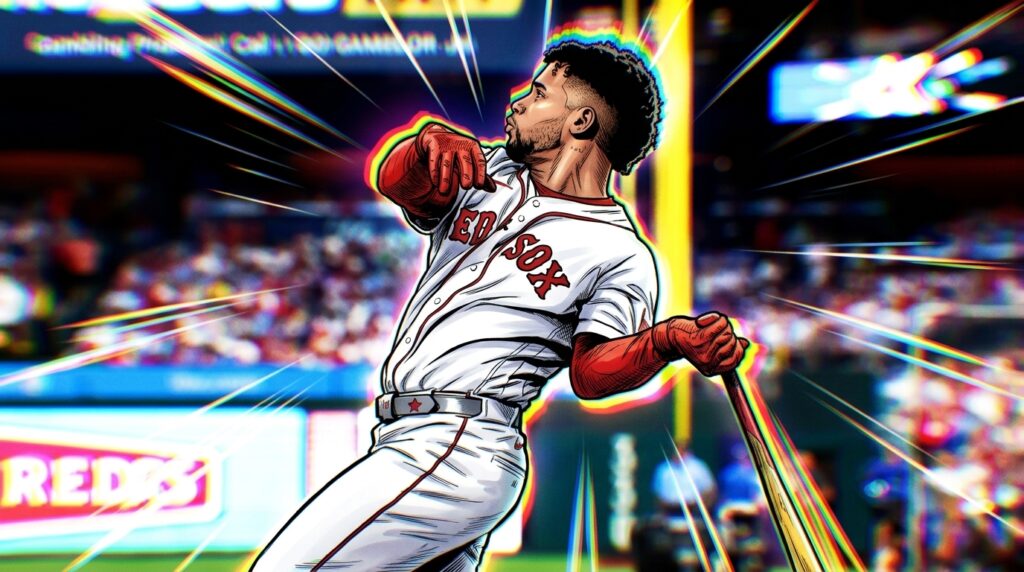
Cade Cavalli used a phrase with documented racist history at Willson Contreras, and Major League Baseball’s considered institutional response was: that’s worth five games, same as the guy who charged the mound. We should say that plainly, because MLB certainly wasn’t going to.
Here’s what happened on June 30 at Fenway Park. Cavalli struck out Contreras on a 3-2 sweeper in the fourth inning. As Contreras walked toward the dugout, Cavalli shouted “Sit down, boy.” Contreras stopped. Asked, “Are you talking to me?” Then charged. Benches cleared. Contreras was ejected. Cavalli — the one who said it — stayed in the game, pitched seven dominant innings, and walked off with a complete performance line: one hit, 13 strikeouts, Nationals win 8-1.
The original injustice happened in that fourth inning. The suspension announcement buried it.
Both players initially received seven-game suspensions. Both were reduced to five on appeal. MLB announced the discipline July 2 without issuing any statement specifically addressing the racial nature of Cavalli’s language. The league just… moved on. Equal punishment, no explanation, see you at the All-Star Game.
Willson Contreras suspended 7 games. Cade Cavalli, too. Miles Mikolas got a 5-game suspension and Nate Eaton suspended for 3 games.
— Chris Cotillo (@ChrisCotillo) July 2, 2026
What makes the equal suspension so damning isn’t that Contreras got punished — he charged the mound, threw his helmet, and then violated MLB’s social media policy by posting on Instagram during an active game. Three separate charges. And he still ended up at the same number as the pitcher who started it. MLB didn’t arrive at equivalence accidentally. They worked backward to get there.
Cavalli, to his credit, did more than most do in these situations. He acknowledged the history. “There’s a history behind that word,” he told media July 1. He said he couldn’t sleep. Said he thought about a 13-year-old Black kid in D.C. who might have looked up to him. That’s a more substantive apology than Josh Donaldson offered in 2022 — when he repeatedly called Tim Anderson “Jackie” and received one game — a precedent that makes Cavalli’s five games look generous by comparison.
But Cavalli’s acknowledgment of history doesn’t change what MLB encoded in the equal suspensions. The institutional message is that using a phrase with documented racist weight at a Black player is equivalent to that player reacting to it. That’s not a neutral accounting. That’s a choice.
Contreras is Venezuelan and didn’t confirm a racial interpretation himself — he told reporters he didn’t know, that he’d let MLB handle it. His restraint speaks for itself. He said he held no grudge, that he was open to meeting with Cavalli. Meanwhile, the Red Sox front office — ownership, Sam Kennedy, Craig Breslow — issued nothing. Interim manager Chad Tracy spoke up on game night, questioned why Cavalli wasn’t ejected, and then got thrown out himself. That was the extent of the organizational response.
This is Fenway Park. In 2017, Adam Jones said fans in the bleachers hit him with racial slurs and threw peanuts. The Red Sox banned a fan for life and made sure Jones got a standing ovation the next night. That was an active response to protect a visiting player — a player from another team. Nine years later, their own first baseman had a phrase with documented racial history directed at him on this same field, and the front office went silent.
Contreras is hitting .285 with 20 home runs and 61 RBIs. He’s an AL All-Star replacement. He’s the player the Red Sox traded three prospects to acquire. The least the organization could do is say something about what happened to him in their own ballpark.
MLB had a chance to draw a clear line: the words that started this are not equivalent to the reaction they caused. Instead, the league issued a math equation. Five equals five. Case closed.
It isn’t closed. And the Red Sox’s silence makes it worse.